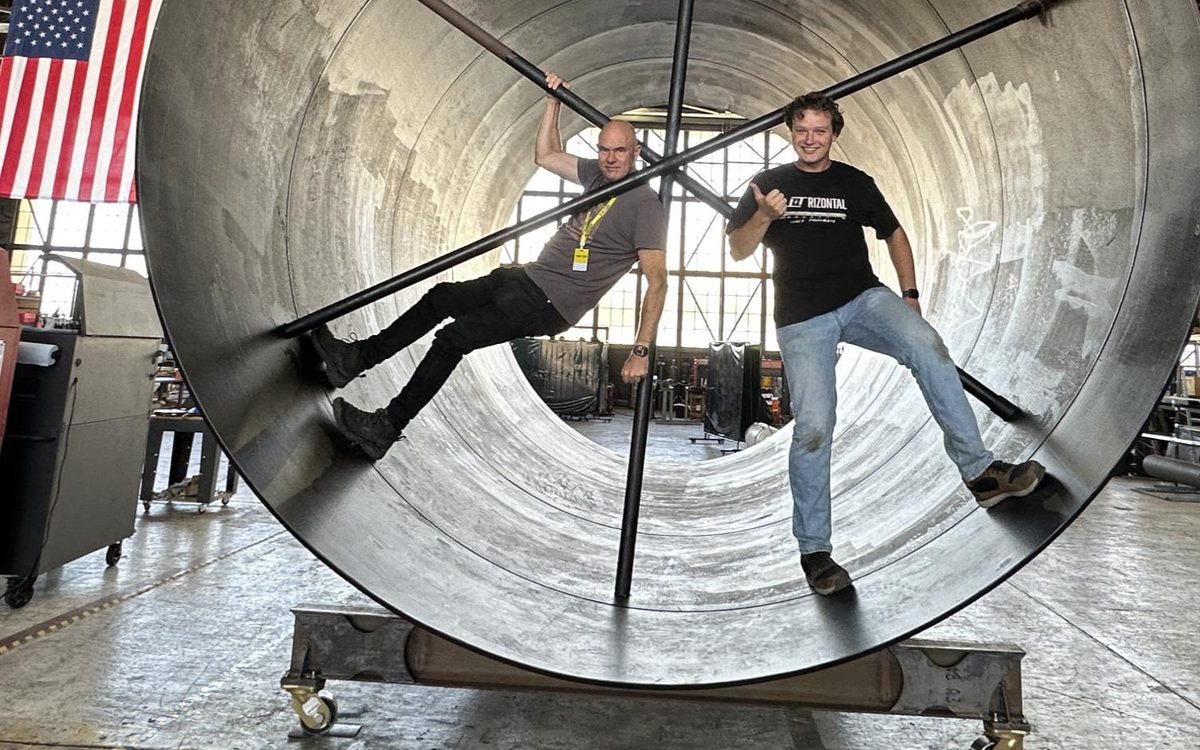
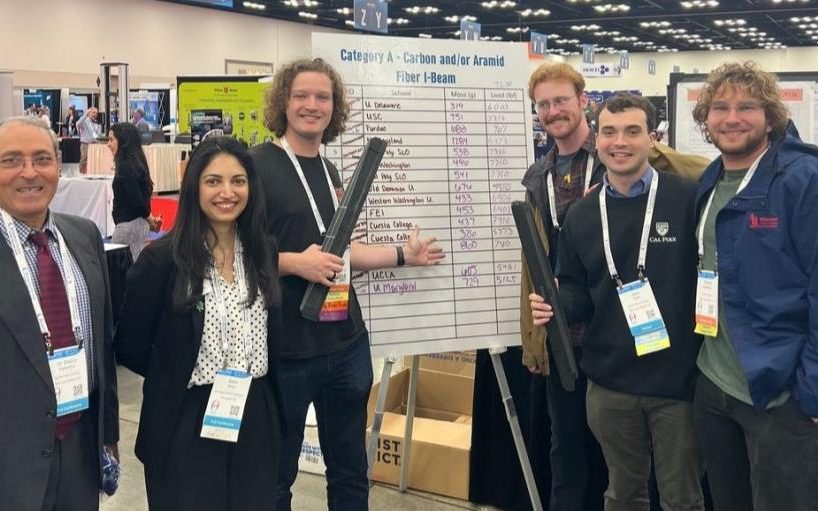
Left: inside the Accelerator Demonstrator at Longshot Space — the stand under it is mine. Right: SAMPE 2025, in front of the Category A board.
Aerospace engineering — composite structures, fabrication, and flight controls
Roderick McLeod
I like structures and things that go fast! highlights are a steel stand carrying an 11-foot diameter accelerator demonstrator at Longshot Space, a linear kinetic launch startup. Composite beams that took first and second in specific strength internationally, and the tooling that made both repeatable. I would call myself a conceptual thinker who isn't afraid to get his hands dirty. I am an aspiring manufacturing / design engineer, one of my goals in life is to be able to get to the point where I can have the knowledge to build anything.
A kinetic launch startup building a ground-based accelerator. I was handed structural problems with short fuses and expected to carry them from requirement to finished hardware.
Designed and manufactured the rolling stand for the Accelerator Demonstrator, an 11 foot diameter 3/4 inch thick 20000lb tube inside my first 2 weeks at Longshot.
Had had Chose an I-beam structure on stiffness per dollar, boxed the sections that needed torsional rigidity, and sourced to what suppliers actually had on the shelf rather than to an ideal BOM.
Sized the swivel-caster mounts with FEA in PrePoMax, then checked the bending moments by hand before anything was cut. Neither method gets trusted alone.
Got the plasma cutter working on day one, diagnosed and repaired its limit switches, chose the CAM software, developed cut parameters for ¼-inch steel and ⅛- and ¼-inch aluminum, then trained others to run it.
Built mounting hardware for test campaigns and ran them. Caught a structural failure mode during testing that was corrected in the next revision.
Created the "Investor Projectile" it is a projectile that was given to the first 100 Longshot Investors, constraints were for it to survive being shot, be under $200 per projectile, and would need to be assembled in under 1 hour. I managed to get that down to $125 per projectile and 20 minutes for assembly, I later found out it was tested, and that the parts had been ordered with no changes made. Order total: $12500.
The Accelerator Demonstrator on the stand, with Scott Manley for scale.Stand frame welded up — boxed where torsional rigidity mattered, gusseted at the caster posts.Cutting gussets on the CNC plasma, on parameters I developed for ¼-inch steel.Assembly in the shop. Four days from requirement to rolling hardware.The investor projectile — three stations, 20-minute cycle time.
Private note, not public: Cleared as public: the stand, the demonstrator tube on the cart, and the projectile. Testing stays generic — no architecture, no campaign specifics, and the instrumented test hardware photos stay out.
SAMPE composite I-beams
President, Cuesta College chapter · Founder, SJSU chapter·2024 — present
A competition to build the structurally most efficient I-beam: carry a design load over a 23-inch span in three-point bending, at the lowest possible mass. I ran the full build-test-iterate cycle, and welded the tooling that made the builds repeatable enough to iterate on at all.
Took 1st and 2nd in specific strength in Category A at SAMPE 2025 — carbon-fiber I-beams, judged on load carried per gram.
Built the lightest beam in the field to meet design load: 431 g carrying 7,200 lb.
Designed and TIG-welded the steel behind it — manufacturing jigs, alignment clamps, test fixtures. The V2 aligner cut build-to-build variance enough that layup changes became measurable instead of noise.
Refined layup schedules and fabrication methods across iterations rather than copying a known-good recipe, which is why the second entry beat the first.
On the natural-fiber side, found that a bamboo and spruce flange-web architecture outperformed more complex flax-composite approaches while being markedly simpler to build — those beams placed 2nd and 3rd lightest to reach design load.
Founded the SJSU chapter, trained its officers, and guest-lectured at San José State and Cal Poly SLO on beam design and competition strategy.
SAMPE 2025, Category A results board — Cuesta entries at 437 g / 7,200 lb and 826 g / 7,900 lb.Four submissions. Two carbon, two natural-fiber — the bamboo and spruce build is the pale one.V2 beam aligner and clamp. Repeatability tooling, welded in-house.Three-point bending fixture, before the interface rework.
prepreg composites
vacuum bagging
TIG welding
jig design
destructive testing
failure analysis
Kestrel — 9 ft tiltrotor VTOL
Aerodynamics and controls·2025 — present
A tilt-trirotor that lifts off vertically on three rotors, then tilts its 22-inch forward pair to transition into wing-borne cruise. I own the aerodynamic characterization and the control-system model.
Built a 1.02 M cell polyhedral mesh holding y+ under 31 across the full wing — down from 163 on the first attempt, after rebuilding the CAD to kill sliver triangles and a knife-edge trailing edge.
Calibrated the transition model against UIUC wind-tunnel polars, then swept angle of attack to find peak L/D of 18.95 at 3° — which lands on the cruise condition rather than near it.
Checked the result against Prandtl lifting-line theory independently: span efficiency e = 0.979, within 4% of the elliptic closed form.
Settled the winglet argument with numbers. Induced drag is 40.6% of the total, but only 0.9% is actually recoverable — and a span extension of equal added area beat winglets 3.8% to 1.9%.
Deriving a state-space plant that carries structural flex as modal coordinates, to compare LQR against PID-with-notch on the same model.
Coupling Simulink to ArduPilot over the SIM_JSON interface at 400 Hz — my aerodynamics as the plant, the real firmware as the controller.
OpenFOAM
ANSYS Fluent Meshing
SolidWorks
Python
MATLAB / Simulink
LQR
ArduPilot
Flight Plan — semester planner
Designed and built·2026
A planner for an engineering course load, built because the generic ones kept lying to me about how much time I had. One self-contained page, roughly 3,300 lines.
Pulls the assignment manifest from Canvas and reconciles it against the syllabus — one of my courses posts graded work only in the syllabus table and never in the assignments tab, so a naive scrape silently misses real deadlines.
Models late-penalty policy per course, so it can tell a deadline that costs 10% from one that costs the whole grade, and prioritize accordingly.
Lays the day out against fixed commitments — class, shop time, training — so the plan reflects hours actually available rather than hours nominally free. That distinction is the entire point.
Flags work that is blocked rather than merely unstarted, which is the failure mode that actually wrecks a week.
Worth building because a planner this specific — one person, one course load — would never have justified the hours before. That calculation has changed.
Private note, not public: The live planner holds my real schedule and stays private. The linked demo is the same interface with entirely fabricated courses and deadlines.
6 kW electric scooter
Designed and built·Personal project
A ground-up electric scooter — pack, drivetrain and chassis hardware. The kind of project where the electrical and the mechanical failure modes are both yours to find.
Designed and assembled a custom high-current battery pack: cell selection, pack layout, balancing, BMS integration, and wiring sized to match.
Fabricated the steel motor mounts and drive hardware, including belt and chain components.
Tuned the BLDC motor and ESC as a system rather than to spec-sheet numbers.
battery pack design
BMS
BLDC / ESC tuning
steel fabrication
Experience
John McLeod SPFX
Special Effects Technician — machining, welding, operator·2021 — present
Machine precision components on manual lathes and mills for special-effects rigging and mechanical assemblies.
TIG and MIG fabrication in aluminum and steel — brackets, frames, test hardware.
Set up, operate and maintain smoke and wind effects equipment for film and live production.
Build custom mechanical solutions and prototypes under tight time and performance constraints.
Local 16
Special FX Technician / Electrics·June 2025 — present
Setup, operation and teardown of special effects and electrics for stage and film, under union and safety procedures.
Wiring, power distribution and equipment checks in fast-paced production environments.
Education
San José State University
B.S. Aerospace Engineering — expected May 2027
Control Systems · Aircraft Flight Mechanics · Flow Field Aerodynamics · Partial Differential Equations
Cuesta College
Coursework in welding and fabrication
San Luis Obispo, CA
Skills
Composites
prepreg
vacuum bagging
wet layup
adhesives
destructive testing
failure analysis
Fabrication
TIG / MIG / stick welding
manual lathe and mill
CNC plasma
soldering
FDM printing
Analysis
PrePoMax FEA
MATLAB
Simulink
Python
CAD
SolidWorks
Fusion 360
AutoCAD
Electrical
high-current battery packs
BMS integration
BLDC motors
ESC tuning
system integration
Other
team leadership
procurement
supplier coordination
scheduling
budgeting
How I work
Anything load-bearing gets checked against a second, independent method before it becomes steel or a flight surface. Solvers, textbooks and models are all perfectly capable of a confident wrong answer, and the check is cheap next to finding out at the test fixture.
On Kestrel I didn't take the CFD at face value. I checked span efficiency against Prandtl lifting-line theory — a completely separate method — and got agreement within 4%. Had they disagreed, one of them was wrong and I'd have wanted to know which before trusting the polar.
On the Longshot stand I ran the bending moment calcs to find a moment of inertia to target, then verified them by hand against a calculator and old strengths-of-materials notes before anything was cut.
I build my own tools when what exists doesn't fit the problem — the planner above, and this site, which I self-host and maintain. I use AI to move quickly on that kind of work, and I check what it hands me.
Writeups
Kestrel CFD calibrationTransition-model calibration against UIUC tunnel data, mesh convergence, and the full wing polar.